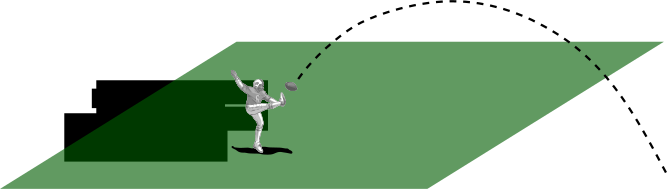
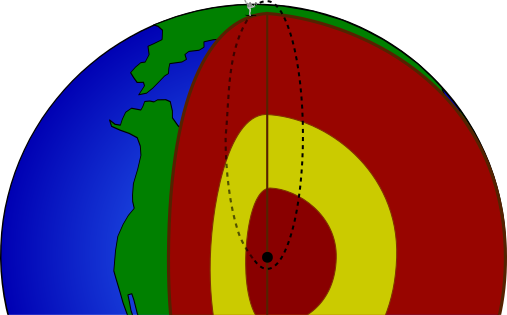
A projectile in a uniform gravity field follows a parabolic path (Fig. 1). But according to Kepler’s First Law the projectile is actually orbitting the center of the Earth in an ellipse (Fig. 2).
The following work demonstrates that they are the same, in the limit where projectile height is much less than the Earth’s radius (\(H \ll R\)). An elliptical orbit looks like projectile motion near the surface of the earth.
In this section we find the trajectory of a projectile, \(y(x)\), in a uniform gravity field. We will find that the trajectory is a concave-down parabola which may be written in the form \(y(x) = H - Ax^2\).
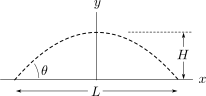
For a projectile launched with initial velocity \(v_0\) at angle \(\theta\) on flat ground (using the coordinate system shown in Fig. 3), the \(x\) and \(y\) coordinates as a function of time are
\[x(t) = - \frac{L}{2} + v_0 t \cos \theta\]
\[y(t) = v_0 t \sin \theta - \tfrac{1}{2}g t^2 \]
where \(L\) represents the range (see Fig. 3). To get \(L\) in terms of the initial velocity (\(v_0\) and \(\theta\)), we need to find the total time of flight, \(t_1\). This is the time (after time \(t=0\)) at which \(y=0\). Setting \(y(t_1)=0\), we find
\[t_1 = \frac{2 v_0 \sin \theta}{g} \]
The range \(L\) is then found from \(x(t_1) = \frac{L}{2}\):
\[ L = \frac{2 }{g} v_0^2 \sin \theta \cos \theta \]
Using this in the expression for \(x(t)\) gives
\[x(t) = -\frac{1}{g} v_0^2 \sin \theta \cos \theta + v_0 t \cos \theta\]
To obtain the trajectory \(y(x)\), we must solve \(x(t)\) for \(t\), and put it into \(y(t)\).
Inverting the \(x(t)\) equation:
\[t = \frac{x }{v_0 \cos \theta} + \frac{1}{g} v_0 \sin \theta \]
Put this into the \(y(t)\) equation:
\[y(x) = x \tan \theta + \frac{1}{g} v_0^2 \sin^2 \theta - \frac{g}{2} \left ( \frac{x^2}{v_0^2 \cos^2 \theta} + \frac{2x \sin \theta}{g \cos \theta} + \frac{v_0^2 \sin^2 \theta}{g^2}\right )\]
\[y(x) = \frac{1}{2g} v_0^2 \sin^2 \theta - \frac{gx^2}{2v_0^2 \cos^2 \theta}\]
This is the parabolic trajectory we sought. It may be easier to recognize written as \(y(x) = H - Ax^2\), where \(H\) and \(A\) are given by
\[H = \frac{1}{2g} v_0^2 \sin^2 \theta \]
and
\[A= \frac{g}{2v_0^2 \cos^2 \theta} \]
Note that at \(x=0\), \(y=H\), which is the maximum projectile height above ground.
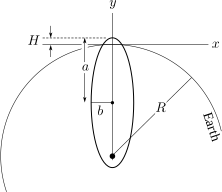
We now aim to show that \(y(x) = H - Ax^2\) is equivalent to the tip of an elliptical path which has the Earth’s center at one focus (Fig. 4).
The general equation of an ellipse (with origin at the ellipse center) is
\[ \left (\frac{y}{a} \right )^2 + \left ( \frac{x}{b} \right )^2 = 1 \]
We want this ellipse to just peak above the Earth’s surface at the origin, so we need a value of \(a\) such that \(2a = R+2H\) (see Fig. 4). The center of the ellipse is a distance \(\tfrac{1}{2}R\) from the origin, so we shift the ellipse equation downward by \(\tfrac{1}{2}R\).
Our ellipse now has the equation
\[ \left (\frac{y+\tfrac{1}{2}R}{a} \right )^2 + \left ( \frac{x}{b} \right )^2 = 1 \]
where \(a = \tfrac{1}{2}R+H\). With these values, the center of the Earth will be at one focus and the origin (at the Earth’s surface) will be at the other focus.
The little bit of the curve where \(y>0\) should be equivalent to the parabolic path. To prove this, we need to show that the ellipse equation, with appropriate choice of \(b\), reduces to \(y = H - Ax^2\) for values of \(y\) such that \(0 < y \le H \ll R\).
Plugging \(a = \tfrac{1}{2}R+H\) into the first term changes it as follows:
\[ \left (\frac{y+\tfrac{1}{2}R}{a} \right )^2 = \left (\frac{y+\tfrac{1}{2}R}{\tfrac{1}{2}R+H} \right )^2 = \left (\frac{\tfrac{1}{2}R}{\tfrac{1}{2}R+H} \right )^2 \left ( 1+ \left ( \frac{\tfrac{1}{2}R+H}{\tfrac{1}{2}R} \right ) \frac{y}{\tfrac{1}{2}R} \right )^2 \]
Note that since \(H \ll \tfrac{1}{2} R\) (that is a height of tens of meters compared to a half-radius of thousands of kilometers), the interior parenthetical expression is very close to 1: \(\left ( \frac{\tfrac{1}{2}R+H}{\tfrac{1}{2}R} \right ) \approx 1\). So the first term in the ellipse equation can be written as
\[ \left (\frac{y+\tfrac{1}{2}R}{a} \right )^2 \approx \left (\frac{\tfrac{1}{2}R}{\tfrac{1}{2}R+H} \right )^2 \left ( 1+\frac{y}{\tfrac{1}{2}R} \right )^2 \]
This can be simplified further. In the domain where \(y \ll R\), this can be rewritten with the binomial approximation: \((1+x)^\alpha \approx 1+ \alpha x\). Here \(x\) represents \(2y/R\) and \(\alpha=2\). So the \(y^2\) factor can be written as
\[ \left ( 1+\frac{y}{\tfrac{1}{2}R} \right )^2 \approx \left ( 1+4\frac{y}{R} \right ) \]
Putting this together into the ellipse equation we obtain
\[ \left (\frac{\tfrac{1}{2}R}{\tfrac{1}{2}R+H} \right )^2 \left ( 1+4\frac{y}{R} \right ) + \left ( \frac{x}{b} \right )^2 = 1 \]
Solving for \(y\):
\[ 1+ \frac{4}{R}y = \frac{4\left (\tfrac{1}{2}R+H \right )^2}{R^2} \left [ 1-\left (\frac{x}{b} \right )^2 \right ]\]
\[y = \frac{\left (\tfrac{1}{2}R+H \right )^2}{R} \left [ 1-\left (\frac{x}{b} \right )^2 \right ] -\frac{R}{4}\]
If we again use the binomial approximation (since \(H \ll R\)), we can show that the constant terms, when combined, are equal to \(H\).
\[ \frac{\left (\tfrac{1}{2}R+H \right )^2}{R} -\frac{R}{4} = \frac{\tfrac{1}{4}R^2 \left ( 1+\frac{2H}{R} \right )^2}{R}-\frac{R}{4} \approx \frac{R}{4} \left ( 1+\frac{4H}{R} \right ) -\frac{R}{4}= H \]
So
\[y = H - \frac{\left (\tfrac{1}{2}R+H \right )^2}{R} \left (\frac{x}{b} \right )^2 \]
This is the parabolic path we sought. Comparing it to the form \(y = H - Ax^2\) shows that the constant \(A\) is related to \(b\) as follows
\[A = \frac{g}{2v_0^2 \cos^2 \theta} = \frac{\left (\tfrac{1}{2}R+H \right )^2}{Rb^2}\]
QED.
If a football player kicks a ball at a 45° angle, with a speed of 25 m/s, then (see calculations here)
This value for \(b\) means that the elliptical orbit is about 20 km wide (half-way to the Earth’s center) and 6400 km long.
Last modified February 2025 by Archie Paulson (Madison College, WI)