In Physics it is often useful to find approximate solutions. The approximations below are examples of linearization, the idea that any smooth function looks linear if you zoom in close enough.
What is “close enough”? We say that \(x\) is “small” if \(|x| \ll 1\). Whether that means \(|x| \lt 0.1\) or \(|x| \lt 0.01\) depends on how accurate you need to be. Some examples are given below.
If \(|x| \ll 1\) then
\[ (1+x)^\alpha \approx 1+ \alpha x. \]
\(\sqrt{1-x} = (1-x)^{1/2} \approx 1-\frac{1}{2}x\)
If \(x = 0.01\), then
\(\sqrt{1-x} = 0.99499\)
\(1-\frac{1}{2}x = 0.995\)
When we study gravitation in Physics 1 we find that the potential energy of a mass \(m\) is a function of its distance from the center of the Earth (mass \(M\)), given by
\[ U_G(r) = - G \frac{Mm}{r} \]
where \(G\) is a univsersal constant (\(G = 6.67 \times 10^{-11}\) N·m²/kg²).
But we also use the fact that near the surface of the Earth, the potential energy of mass \(m\) is a linear function of its height \(y\), given by
\[ U_G(y) = mgy \]
where \(g = 9.8\) N/kg. Here \(g\) is the gravitational field strength on the Earth’s surface, given by \(g = GM/R^2\), where \(R\) is the Earth’s radius.
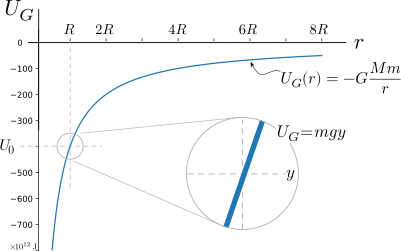
How can both of these \(U_G\) functions be true? Because the latter is a linear approximation of the former. Zooming in around \(r=R\), the curve is a straight line.
To show this with the binomial approximation, start with \(U_G(r)\), and look at a distances near the Earth surface: \(r=R+y\), with \(y \ll R\).
\[ \begin{aligned} U_G(r) &= - G \frac{Mm}{r} \\ &= - GMm r^{-1} \\ &= - GMm (R+y)^{-1} \\ &= - \frac{GMm}{R} \left( 1+\frac{y}{R} \right)^{-1} \\ \end{aligned} \]
Now, since height \(y\) will be at most a couple kilometers, but \(R=6357\) km, we have \(y/R \ll 1\). So use the binomial approximation:
\[ \begin{aligned} U_G(r) &\approx - \frac{GMm}{R} \left( 1 - \frac{y}{R} \right) \\ &= - \frac{GMm}{R} + \frac{GMm}{R^2} y \\ &= - \frac{GMm}{R} + m \left( \frac{GM}{R^2} \right) y \\ &= U_0 + mg y \\ \end{aligned} \]
Here we call the first term \(U_0\), an arbitrary constant offset, and we see the linear behavior \(mgy\).
If \(|\theta| \ll 1\) (in radians) then \[ \begin{matrix} \sin \theta \approx \theta \\ \tan \theta \approx \theta\\ \cos \theta \approx 1 \end{matrix} \]

\(\sin(0.01) = 0.0099998\)
\(\tan(0.01) = 0.0100003\)
\(\cos(0.01) = 0.99995\)
The theory applied in both approximations above is that of the Taylor series. Any smooth function \(f(x)\) may be approximated (in the neighborhood of \(x=a\)) by a polynomial as follows
\[ f(x) = \sum_{n=0}^{\infty} \frac{f^{(n)}(a)}{n!} (x-a)^n = f(a) +f'(a) (x-a) + \frac{1}{2} f''(a) (x-a)^2 + ... \]
where \(f^{(n)}(a)\) is the \(n\)th derivative of function \(f\) evaluated at \(x=a\). Writing a function this way is often called “expanding \(f(x)\) about \(x=a\)”.
Using this polynomial, we see that if we zoom in to a small domain near the point \(x=a\), then \(|x-a| \ll 1\), and then terms like \((x-a)^2\) or higher powers will be so small they can be neglected. Dropping these, the function can be approximated as a linear function:
\[ f(x) \approx f(a) + f'(a) (x-a) = mx+b \]
where the slope \(m=f'(a)\), and the constant \(b=f(a) - af'(a)\). The graph above shows how a curve looks like a straight line when you zoom in enough.
Expanding \(f(x) = \sin x\) about the point \(x=0\) gives the small angle approximation:
\(\displaystyle \sin x = \sin(0) + \cos(0) x + ... \approx 0 + 1 x = x\)
Expanding \(f(x) = (1+x)^\alpha\) about the point \(x=0\) gives the binomial approximation. Note that \(f(0) = 1^\alpha =1\), and \(f'(0) = \alpha (1+0)^{\alpha-1} = \alpha\).
\(\displaystyle (1+x)^\alpha = f(0) + f'(0) x + ... \approx 1 + \alpha x\)
Last modified: April 09, 2025
