Every measurement should be made as accurately as possible. A physical measurement is only truely meaningful if its uncertainty is also recorded.
To express the uncertainties we will use both of the following:
| Absolute uncertainty | \(x \pm \delta x\) (units) | |
| Relative uncertainty | \(x\) (units) \(\pm \; z\)% |
where \(\delta x\) is \(z\)% of \(x\).
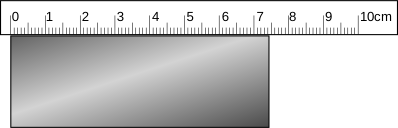
Suppose you used a ruler to measure the object shown.
This length might be recorded as \(7.45\) ± \(0.02\) cm. The last digit (5) has been interpolated between the finest graduations of the ruler, and the uncertainty expresses the minimum range of values that I’m sure the measurement falls in. The percent uncertainty would be \(7.45\) cm ± \(0.27\)% – this is because \(0.02\) is \(0.27\)% of \(7.45\). The units are written only by the first value since the percentage is dimensionless.
For devices with a digital readout, assuming they are functioning properly, uncertainty may be taken as \(\pm 1\) in the last digit of the readout. Another method is to repeat the measurement to see if the digital value changes. If so the uncertainty should reflect this variability.
Data derived from measurements should also be recorded with their uncertainty. We say that the uncertainty propagates through the calculation. We will not develop the theory here except for two approximate rules for addition/subtraction and multiplication/division.
Example: A sphere’s diameter is measured to be \(d=10.7\) ± \(0.3\) mm. It’s radius is given by \(r=d/2\), so we must add the relative uncertainties in \(d\) and the number \(2\); but the uncertainty in this value of 2 is exactly zero. So \(d=10.7\) mm ± \(2.8\)%, and \(r=5.35\) mm ± \(2.8\)%. The sphere’s volume is \(V=\tfrac{4}{3} \pi r^3\), where \(\tfrac{4}{3} \pi\) has zero uncertainty. Since \(r^3=r \cdot r \cdot r\), we must add the relative uncertainty in \(r\) to itself three times: \(V=641\) mm³ ± \(8.4\)% = \(641 \pm 54\) mm³.
The digits that are actually measured (including the one digit that is estimated) are called the significant figures. The concepts of significant figures and how they behave when multiplied or added are covered in your text (section 1.6), which you should review for a detailed discussion. When written in scientific notation, all digits are considered significant.
The number of significant figures should be consistent with the value’s uncertainty.
Notation
In published scientific data, you will often find uncertainties in parentheses. In this style, the ruler measurement above could be written as \(7.45(2)\) cm. Here, the \((2)\) means \(\pm 2\) in the last digit. The sphere’s diameter (example above) would be \(10.7(3)\) mm.
See, for example, the Recommended Values
of the Fundamental Physical Constants (pdf) at
physics.nist.gov.
Using Python
As calculations become more complex, using a computer to propagate
the uncertainty is much preferred. In Python you may use the uncertainties
package. Here is one way to perform the example calculation from
above:
import uncertainties,math
d = uncertainties.ufloat_fromstr("10.7+/-0.3")
V = 4/3*math.pi*(d/2)**3
print(V)
(6.4+/-0.5)e+02
The output agrees with the example calculation.