Trigonometry
Trigonometry is named for the triangle, but there is far more to it:
circles, vectors, oscillations and waves, the exponential function, and
more.
Triangles – Graphs –
Formulas – Radians
vs degrees – Calculus – Euler’s formula – Going further
Triangles
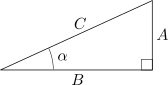
For the right triangle shown at the left,
\(\displaystyle \sin \alpha =
\frac{A}{C}\)
\(\displaystyle \cos \alpha =
\frac{B}{C}\)
\(\displaystyle \tan \alpha =
\frac{A}{B}\)
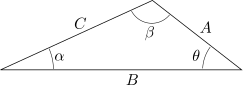
For any triangle, such as the one at the right,
\(A^2 + B^2 - 2AB \cos \theta =
C^2\)
\(\displaystyle \frac{\sin \alpha}{A} =
\frac{\sin \beta}{B} = \frac{\sin \theta}{C}\)
These are called the “Law of Cosines” and the “Law of Sines”,
respectively.
Examples:
- For any triangle, you can determine all sides and angles by knowing
- two sides and one angle – Use the Law of
Cosines to find the unknown side (you may need to use the quadratic
formula). Then use it again to find the unknown angles.
- three sides and no angles – Use the Law of
Cosines to find each unknown angle.
- two angles and one side – Use the Law of
Sines to find one unknown side. Then use the Law of
Cosines to find the rest.
- Careful with the inverse-sine. For example, the triangle above at
the right has \(B=2\), \(C=1.4\) and \(\theta=40^\circ\). If you used the Law
of Sines to find angle \(\beta\),
you would calculate \(\sin \beta = \frac{B}{C}
\sin \theta = 0.918\). Then you would find \(\beta = \sin^{-1} 0.918 = 66.7^\circ\), but
that can’t be right, since you can see that \(\beta > 90^\circ\). The problem is that
\(\sin 66.7^\circ = \sin
(180-66.7)^\circ\), and your calculator doesn’t give both
answers. The Law of Sines is correct, with \(\beta = 113.3^\circ\).
Graphs
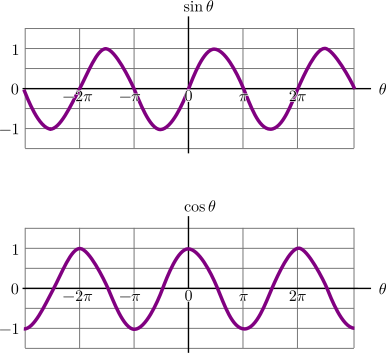
It is important to be familiar with the shapes of the sine and cosine
graphs.
- \(\cos^2 \theta + \sin^2 \theta =
1\)
-
This is the most important trigonometric identity. Among many other
uses, it underpins our definition of the unit vector.
- \(\cos \theta = \sin \left( \theta +
\frac{\pi}{2} \right)\)
\(\sin
\theta = \cos \left( \theta - \frac{\pi}{2} \right)\)
-
A quarter-cycle phase shift can convert a sine to a cosine, and back.
This should be apparent from a careful look at their
graphs.
- \(\cos 2 \theta = \cos^2 \theta - \sin^2
\theta\)
\(\sin 2 \theta = 2 \sin
\theta \cos \theta\)
-
The double-angle formulas are occasionally useful. If you forget them
you can easily re-derive them from Euler’s
formula.
- \(e^{i \theta} = \cos \theta + i \sin
\theta\)
-
Euler’s formula is so important it has its own section below.
Radians vs degrees
Both of these angular measures are commonly used.
- An angle in radians is defined as the ratio of arc
length to radius (\(\theta = s/r\)),
with \(2 \pi\) radians in a
circle.
- Degrees have been used since ancient
Babylonia. With \(360^\circ\) in a
circle, you may convert degrees to radians with the factor \(\frac{2 \pi}{360} = \frac{\pi}{180}\).
Further comments:
- Some equations work using either radians or degrees (eg, \(\sin \theta\), as long as your calculator
is set correctly). Some equations require radians (eg, \(\frac{d}{d\theta} \sin \theta = \cos
\theta\)). If you’re not sure if degrees will work, use radians
which always work.
- Computers (the Jupyter Notebook for
example) require radians as arguments of the trig functions.
- Angles have units (degrees or radians) but are dimensionless
quantities. This is easy to see with radians, defined by \(s/r\), which is length/length. Degrees are
arbitrary subdivisions of a full circle, they are also dimensionless.
(See notes on dimensional analysis.)
- It was an unfortunate historical
accident that the symbol \(\pi\)
was given to half the true circle constant (which is \(2 \pi\), the number of radians in a
circle). The true circle constant is sometimes given the symbol \(\tau\), the Greek letter tau. Then a \(90^\circ\) angle is, naturally, \(\tau/4\), because it is a quarter-circle.
Read and share the tau
manifesto, and join the tauists!
Calculus
Derivatives
These derivatives should be memorized:
\(\displaystyle \frac{d}{d\theta} \sin
\theta = \cos \theta\)
\(\displaystyle \frac{d}{d\theta} \cos
\theta = - \sin \theta\)
If you forget these but can sketch their
graphs, you can work them out. Notice the slope of \(\sin \theta\) graph follows the \(\cos \theta\) graph. The slope of \(\cos \theta\) graph follows the opposite of
the \(\sin \theta\) graph.
Don’t forget about the chain rule: \(\displaystyle \frac{d}{dt} \sin \omega t = \omega
\cos \omega t\).
Integrals
These are just anti-derivatives.
\(\displaystyle \int \sin \theta = -\cos
\theta +C\)
\(\displaystyle \int \cos \theta = \sin
\theta +C\)
You’ll sometimes need the inverse-chain rule (also called \(u\)-substitution): \(\displaystyle \int \sin \omega t = -
\frac{1}{\omega} \cos \omega t +C\).
When \(x\) is a real number, the
exponential function \(e^x\) describes
exponential growth and decay. When the argument is imaginary, it is made
of the trig functions:
\[e^{ix} = \cos x + i \sin x\]
This is a very useful result.
In the complex plane, a number’s imaginary part is on the vertical
axis and real part is on the horizontal axis (review
complex numbers here). In this way, complex number \(a+ib\) is like the vector \(a \hat{\imath} + b \hat{\jmath}\). (In fact
vector math was historically
derived from complex math.)
In the same way, any complex number \(a+ib\) can be written in “polar form” as
\(r e^{i \theta}\), where \(r=\sqrt{a^2 + b^2}\) and \(\theta\) is the angle the “vector” makes
with the real axis.
Examples
- Derivatives are as expected:
- \(\frac{d}{dx} e^{ix} = ie^{ix} = i(\cos x
+ i \sin x) = -\sin x + i \cos x\)
- The real part equals \(\frac{d}{dx} \cos
x\) and the imaginary part equals \(\frac{d}{dx} \sin x\).
- The double-angle trig identities are easy to derive:
- \(e^{i(2x)} = (e^{ix})^2 = (\cos x + i
\sin x)^2 = \cos^2 x - \sin^2 x + 2i \sin x \cos x\)
- \(e^{i(2x)} = \cos 2x + i \sin
2x\)
- Equating the real parts gives \(\cos 2x =
\cos^2 x - \sin^2 x\).
- Equating the imaginary parts gives \(\sin
2x = 2 \sin x \cos x\).
- You can do a similar trick to derive the quarter-cycle phase shifts and the angle-sum
formulas such as \(\sin (\alpha \pm
\beta)\).
Further notes
- Euler’s formula is not difficult to prove if you’re familiar with Taylor
series. Just expand \(e^{ix}\) and
you’ll see the the sine and cosine expansions pop out.
- Complex exponentials are essential to solving certain differential equations.
Going further
At some point I may add more about the following. Please inquire if you’re curious
about them.
- polar coordinates
- phasors
- harmonic motion
- small angle approximation
- fourier analysis
- spherical harmonics
- solid angles – Just as an angle in radians is defined by \(\theta = \frac{s}{r}\), a solid
angle in steradians is defined by \(\Omega = \frac{A}{r^2}\), where \(A\) is a patch of area on a sphere of
radius \(r\) subtended by \(\Omega\). There are \(4 \pi\) steradians in a sphere.
- coordinate rotation
Last modified: October 31, 2025