Computing the Gravity Field of a Spherically Symmetric Mass
This work shows that outside of any spherically symmetric mass distribution (such as a planet) the gravity field is identical to that of a point particle with equal mass. It also shows that inside any spherically symmetric mass shell (such as a planet with a concentric spherical cavity), gravity is zero throughout the interior.
Newton’s law of universal gravitation tells us that the gravity field at point \(P\) due to a point mass \(m\) can be written
\[\vec{g}(P) = - \frac{ Gm }{r^2} \hat{r} \]
where vector \(\vec{r}\) (magnitude \(r\) in the direction of unit vector \(\hat{r}\)) is directed from the point mass \(m\) to point \(P\), and \(G\) is the universal gravity constant.
In the work below we calculate the gravity field \(\vec{g}\) at point \(P\) a distance \(z\) away from the center of a spherically symmetric mass shell. The result is that inside the shell gravity cancels to zero, and outside it is equal to the gravity of a point mass.
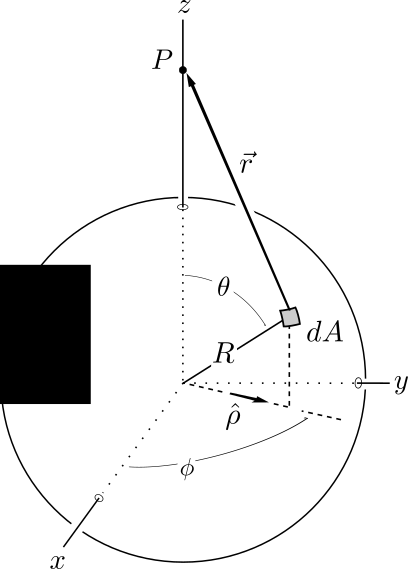
We place the coordinate axes at the center of the sphere, and use the following symbols (see Fig. 1):
The gravity field at \(P\) will be the vector sum of the contributions (\(d\vec{g}\)) from all the point sources (\(dm\)) on the spherical shell. Writing \(dm = \sigma \; dA\) and \(\hat{r}= \vec{r}/r\), the sum is
\[ \begin{aligned} \vec{g}(P) &= \int d\vec{g} \\ &= \int -\frac{G \;dm}{r^2} \hat{r} \\ &= - G \sigma \int \frac{ \vec{r} }{r^3} \;dA \\ \end{aligned} \]
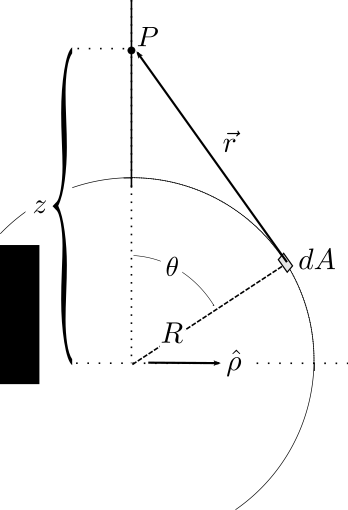
The vector \(\vec{r}\) can be found from the fact that \(\vec{R} + \vec{r} = z \hat{k}\) (see Fig. 2):
\[\vec{r} = z \hat{k} - \vec{R} = z \hat{k} - R( \hat{k} \cos \theta + \hat{\rho} \sin \theta ) \]
Find the magnitude of \(\vec{r}\) from law of cosines.
\[r^2 = R^2 + z^2 - 2Rz\cos \theta \]
The area element in spherical coordinates is
\[dA = R^2 \sin \theta \; d\theta d\phi\]
Note that \(\vec{r}\) changes in magnitude and direction as we integrate over different parts of the shell, but \(R\) (magnitude of \(\vec{R}\)) is a constant. Plugging the above expressions into the integral:
\[\vec{g}(P) = -G \sigma R^2 \int_\theta \int_\phi \frac{ (z - R\cos \theta) \hat{k} -\sin \theta \; \hat{\rho} }{\left (R^2+z^2 - 2Rz\cos\theta \right )^{3/2}} \sin \theta \; d\theta d\phi\]
Integrating over \(\phi\), which goes from \(0\) to \(2 \pi\), is easy since the only \(\phi\) dependence in the integrand is in \(\hat{\rho}\). So the first term in the numerator (with \(\hat{k}\)) just gets a factor of \(2 \pi\). The second term (with \(\hat{\rho}\)) evaluates to zero due to axial symmetry. We are then left with
\[\vec{g}(P) = -2\pi G \sigma R^2 \int_\theta \frac{ (z - R\cos \theta) \hat{k} }{\left (R^2+z^2 - 2Rz\cos\theta \right )^{3/2}} \sin \theta \; d\theta \]
The result has only a \(\hat{k}\) component. Also, note that the total mass of the sphere is \(M = 4 \pi R^2 \sigma\), so the result simplifies to
\[\vec{g}(P) = - \frac{GM}{2} \hat{k} \int_0^{\pi} \frac{ z - R\cos \theta }{\left (R^2+z^2 - 2Rz\cos\theta \right )^{3/2}} \sin \theta \; d\theta \]
We will solve the integral by first getting the variable \(\theta\) in terms of \(r\).
Using \(r^2 = R^2 + z^2 - 2Rz\cos \theta\), we find
\[-R \cos \theta = \frac{r^2 -z^2-R^2}{2z}\]
The numerator of the integrand can now be written as
\[z - R\cos \theta = z+ \frac{r^2 - z^2 - R^2 }{2z} = \frac{r^2 + z^2 -R^2}{2z} \]
The differential quantity \(d \theta\) can be converted to \(dr\) using \(r = \sqrt{ R^2 + z^2 - 2Rz\cos \theta}\), as follows:
\[ \frac{dr}{d\theta} = \frac{1}{2r}2Rz\sin \theta \]
So
\[ \sin \theta \; d\theta = \frac{r}{Rz} dr \]
We can now evaluate the integral using the above relations. The integration limits are from \(\theta=0\) to \(\pi\), which will correspond to \(r\) going from \(r_1\) to \(r_2\). We will consider the integration limits in a moment.
\[ \begin{aligned} \vec{g}(P) &= - \frac{GM}{2} \hat{k} \int_{r_1}^{r_2} \left (\frac{1}{2z} \right ) \left (\frac{r^2 +z^2 -R^2}{r^3} \right ) \frac{r}{Rz} \; dr \\ &= - \frac{GM}{4Rz^2} \hat{k} \int_{r_1}^{r_2} \left ( 1 + \frac{z^2 -R^2}{r^2} \right ) \; dr \\ &= - \frac{GM}{4Rz^2} \hat{k} \left [ r + \left ( z^2 -R^2 \right ) \left (-\frac{1}{r} \right ) \right ]_{r_1}^{r_2} \\ &= - \frac{GM}{4Rz^2} \hat{k} \left [ r + \left ( R^2 -z^2 \right ) \left (\frac{1}{r} \right ) \right ]_{r_1}^{r_2} \\ \end{aligned} \]
The integration limits \(r_1\) and \(r_2\) (corresponding to \(\theta=0\) and \(\pi\)) require some special attention. Note that if \(P\) is outside the spherical shell then \(z>R\), and if \(P\) is inside the spherical shell then \(R>z\) (see the figures above). This means the integration limits will be different depending on whether \(P\) is inside or outside. For each condition we use \(r = \sqrt{R^2 + z^2 - 2Rz\cos \theta}\) to find the limits.
For \(P\) outside the spherical shell:
\[ \begin{matrix} \theta =0 & (\rm{top\; of \; sphere}) & r_1 = z-R \\ \theta =\pi & (\rm{bottom\; of \; sphere}) & r_2 = z+R \\ \end{matrix} \]
For \(P\) inside the spherical shell:
\[ \begin{matrix} \theta =0 & (\rm{top\; of \; sphere}) & r_1 = R-z \\ \theta =\pi & (\rm{bottom\; of \; sphere}) & r_2 = z+R \\ \end{matrix} \]
Evaluating at these limits:
\[ \vec{g}(P) = - \frac{GM}{4Rz^2} \hat{k} \left\{ \begin{matrix} z+R -z+R+(R^2-z^2)\left ( \frac{1}{z+R} - \frac{1}{z-R} \right ) & P \; \rm{outside\; shell} \\ & \\ z+R -R+z+(R^2-z^2)\left ( \frac{1}{z+R} - \frac{1}{R-z} \right ) & P \; \rm{inside\; shell} \end{matrix} \right\} \]
The expressions in curly braces can simplify dramatically. For \(P\) outside the shell:
\[ 2R+(R^2-z^2)\left ( \frac{z-R-z-R}{z^2-R^2} \right ) = 2R - (-2R) = 4R \]
And for \(P\) inside the shell:
\[ 2z+(R^2-z^2)\left ( \frac{R-z-R-z}{z^2-R^2} \right ) = 2z +(-2z) =0 \]
So:
\[ \vec{g}(P) = \left\{ \begin{matrix} - \frac{GM}{z^2} \hat{k} & P \; \rm{outside\; shell} \\ & \\ \vec{0} & P \; \rm{inside\; shell} \end{matrix} \right\} \]
The last line above says that if point \(P\) is outside the spherical shell,
\[\vec{g}(P) = - \frac{GM}{z^2} \hat{k}\]
which is the gravity of a point mass \(M\) a distance \(z\) away.
And if point \(P\) is inside the spherical shell (no matter how far from the center), there is zero net gravity.
As a corollary, since any spherically symmetric mass distribution (such as the Earth, approximately) is simply a composite body formed of many spherical shells:
Last modified November 2023 by Archie Paulson (Madison College, WI)